
All India Muslim Personal Law Board Strongly Opposes UCC in Gujarat and Uttarakhand, Calls It Unconstitutional and Politically Motivated
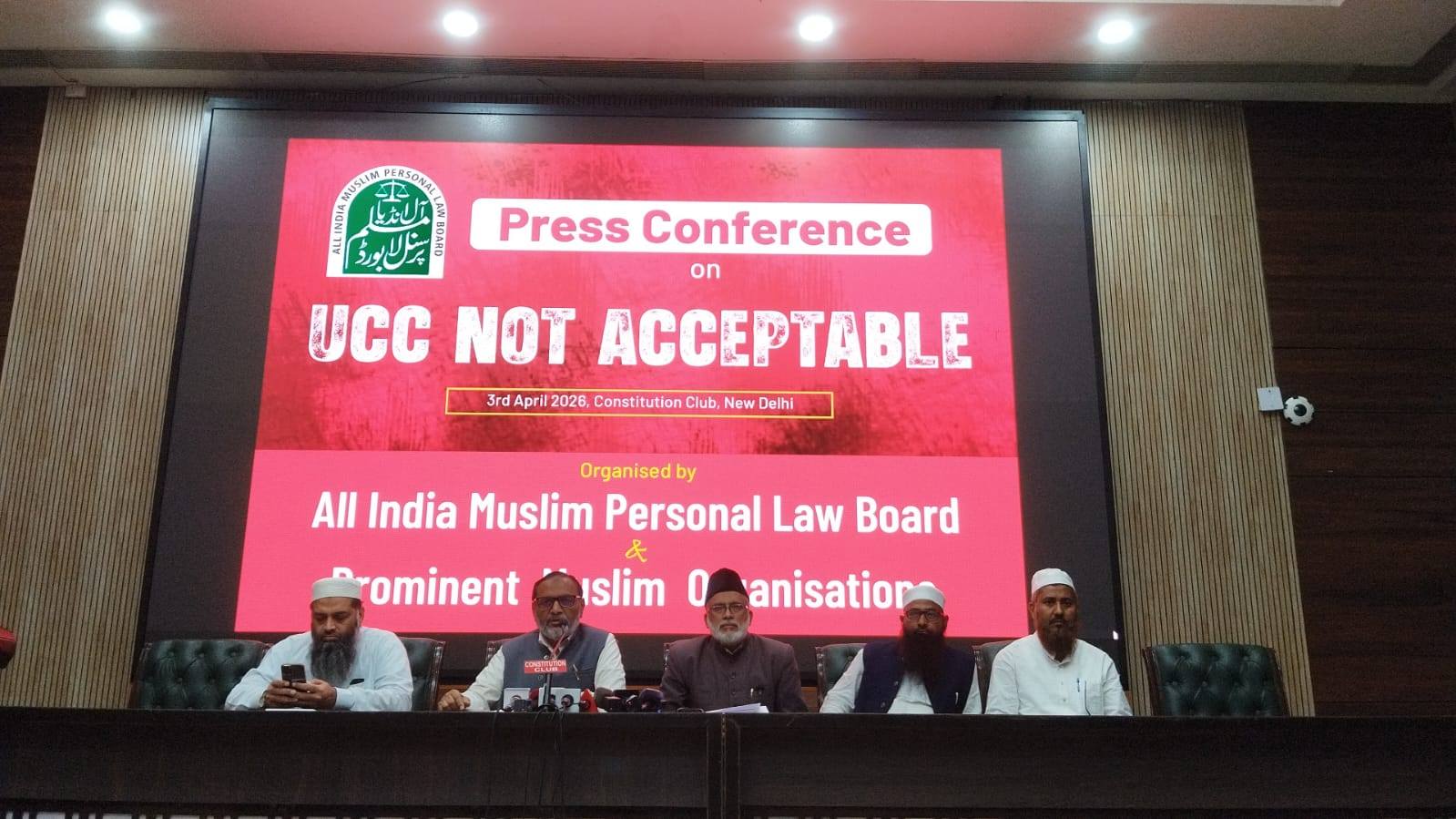
Those addressing the Press Conference :
Ml. Md. Ali Mohsin Taqi, Vice President, AIMPLB and Imam & Khatib, Shia Jama Masjid, Delhi
Maulana Asghar Ali Imam Mehdi Salafi, Vice President, AIMPLB and President, Markazi Jamiat Ahl-e-Hadith Hind
Mr. Malik Moatasim Khan, Deputy Ameer, Jamaat-e-Islami Hind and Board Member
Advocate Tahir M. Hakim, Member, AIMPLB
Dr. S. Q. R. Ilyas, Spokesperson, AIMPLB
Image Source : AIMPLB.
Dated 3rd April 2026
News By Dr. B R Abdul Wajid
Editor in Chief
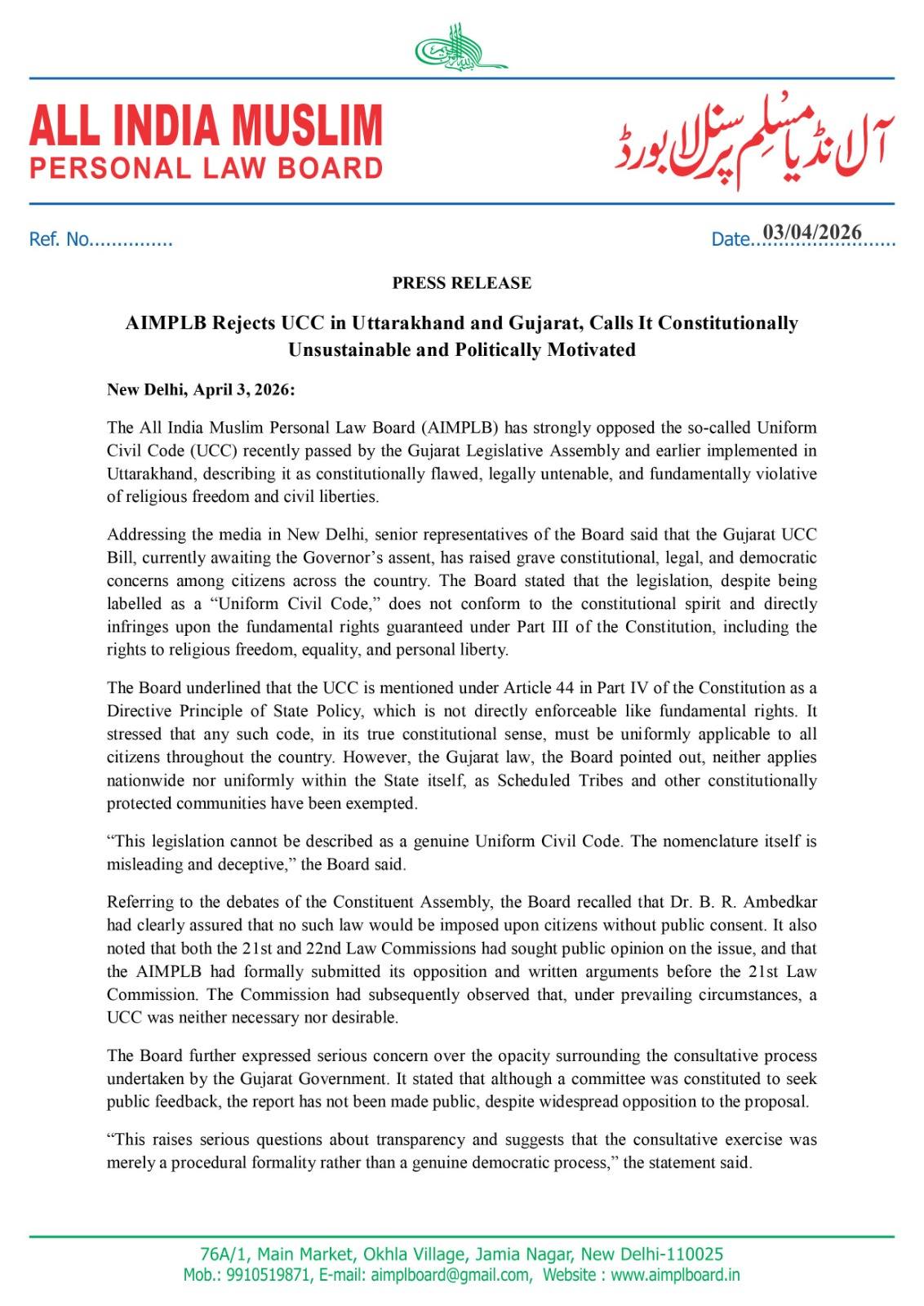
New Delhi | The All India Muslim Personal Law Board has strongly opposed the Uniform Civil Code (UCC) recently passed by the Gujarat Legislative Assembly and earlier implemented in Uttarakhand. The Board has described the move as constitutionally flawed, legally weak and against religious freedom and civil liberties.
Addressing the media in New Delhi during a Press Conference today, senior members of the Board said that the Gujarat UCC Bill, which is currently awaiting the Governor’s approval, has raised serious constitutional, legal and democratic concerns among citizens across the country. They stated that although it is called a “Uniform Civil Code,” it does not reflect the true spirit of the Constitution and directly affects fundamental rights such as religious freedom, equality and personal liberty.
The Board explained that the UCC is mentioned under Article 44 in Part IV of the Constitution as a Directive Principle of State Policy, which is not legally enforceable like fundamental rights. It said that a true Uniform Civil Code should be equally applicable to all citizens across the country. However, according to the Board, the Gujarat law is neither applicable nationwide nor uniformly within the state, as Scheduled Tribes and certain protected communities have been kept outside its scope. The Board also termed the name “Uniform Civil Code” as misleading and deceptive.
Referring to the debates of the Constituent Assembly, the Board recalled that Dr. B. R. Ambedkar had assured that no such law would be imposed on citizens without their consent. It also pointed out that both the 21st Law Commission of India and the 22nd Law Commission of India had sought public opinion on the issue. The AIMPLB stated that it had submitted its objections before the 21st Law Commission, which later observed that a UCC was neither necessary nor desirable under the present circumstances.
The Board expressed serious concern over the lack of transparency in the consultation process by the Gujarat Government. It said that although a committee was formed to gather public feedback, its report has not been made public despite widespread opposition.
“This raises serious questions about transparency and shows that the consultation process may have been only a formality,” the Board said.
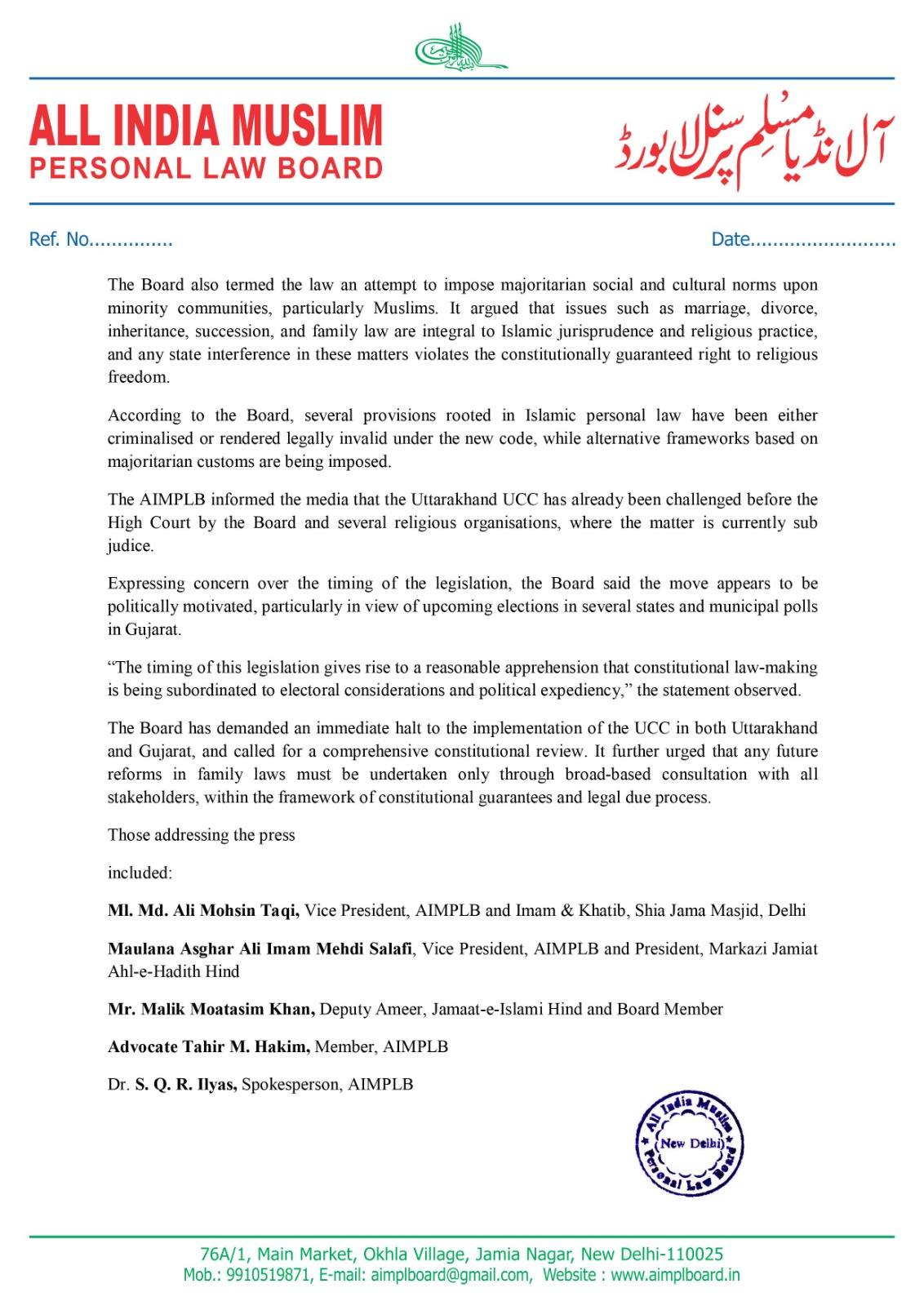
Further, the Board alleged that the law is an attempt to impose majority social and cultural practices on minority communities, particularly Muslims. It stated that matters such as marriage, divorce, inheritance, succession, and family laws are integral to Islamic religious practices, and any interference in these areas would violate the constitutional right to religious freedom.
According to the Board, several provisions of Islamic personal law have been either criminalised or made legally invalid under the new code, while alternative frameworks based on majority customs are being imposed.

The AIMPLB also informed the media that the Uttarakhand UCC has already been challenged before the High Court by the Board and other religious organisations, and the matter is currently under consideration.
Raising concerns over the timing, the Board said the move appears politically motivated, especially with upcoming elections in several states and municipal polls in Gujarat.
“The timing of this legislation raises serious doubts that constitutional law-making is being influenced by electoral considerations,” the statement noted.
The Board has demanded an immediate halt to the implementation of the UCC in both Uttarakhand and Gujarat and called for a detailed constitutional review. It also urged that any future reforms in family laws should be carried out only after wide consultation with all stakeholders and strictly within the framework of constitutional rights and legal procedures.
The All India Muslim Personal Law Board has made it clear that it will continue to oppose the implementation of the Uniform Civil Code through legal and democratic means. The Board has called upon the government to respect constitutional values, ensure transparency and protect the religious and cultural rights of all communities, while stressing that any major legal reform must be based on dialogue, inclusiveness and public consensus.
News By Dr. B R Abdul Wajid